The One Writing Shift That Changed Everything For My LinkedIn Results
KANIKA ENERGY COACH > PODCAST AND MEDIA APPEARANCES
There is something I keep hearing from business owners on LinkedIn.
“I’m posting consistently.”
“I’m sharing valuable content.”
“I’m doing everything people told me to do.”
“But my reach is still going down.”
And honestly, I understand the frustration.
There is more content being published on LinkedIn than ever before. More coaches. More consultants. More AI-generated carousels. More five-step frameworks telling you how to grow your audience, build a personal brand, or sign more clients.
So, yes, you may be posting more.
But so is everybody else.
As a business growth coach, I do not think the answer is simply to publish more content. The real question is: why should somebody stop and read yours?
Because information alone is no longer enough.
AI Has Made Information Easy to Access
Let’s say you want to write a post about getting clients from LinkedIn.
You could open ChatGPT right now and ask:
“Give me five ways to generate leads through LinkedIn.”
Within seconds, you would receive a perfectly reasonable list.
Improve your profile.
Post consistently.
Engage with your audience.
Send personalised messages.
Follow up with leads.
There is nothing technically wrong with that advice.
But there is also nothing particularly memorable about it.
Every online business coach, business consultant, and creator using AI can generate exactly the same information.
This is why generic “how-to” content is becoming easier to ignore.
Your audience does not need another basic list of tips. They can find that information anywhere.
What they cannot find anywhere else is your experience.
Your story.
Your mistakes.
Your results.
Your way of looking at the problem.
That is where the opportunity now sits.
Move From “How To” Content to “How I” Content
This is the shift I want you to make.
Instead of writing only “how to” content, start writing more “how I” content.
For example, instead of:
How to get more clients from LinkedIn
you could write:
How I booked six calls from one LinkedIn post—and what I said differently
Instead of:
Five ways to grow your LinkedIn audience
you could write:
How I gained 400 followers in 30 days after changing one line in my hook
Can you feel the difference?
The first version gives information.
The second creates curiosity.
It gives us a real person, a real outcome, and a specific moment we want to understand.
This does not mean every post has to become a dramatic personal story.
It means your content needs to carry evidence that you have lived what you are talking about.
That is especially important if you position yourself as a business growth advisor, business strategy coach, or small business consultant.
People are not only asking, “What do you know?”
They are asking:
“Have you seen this problem before?”
“What happened when you tried this?”
“What did you learn?”
“Can I trust you to guide me through it?”
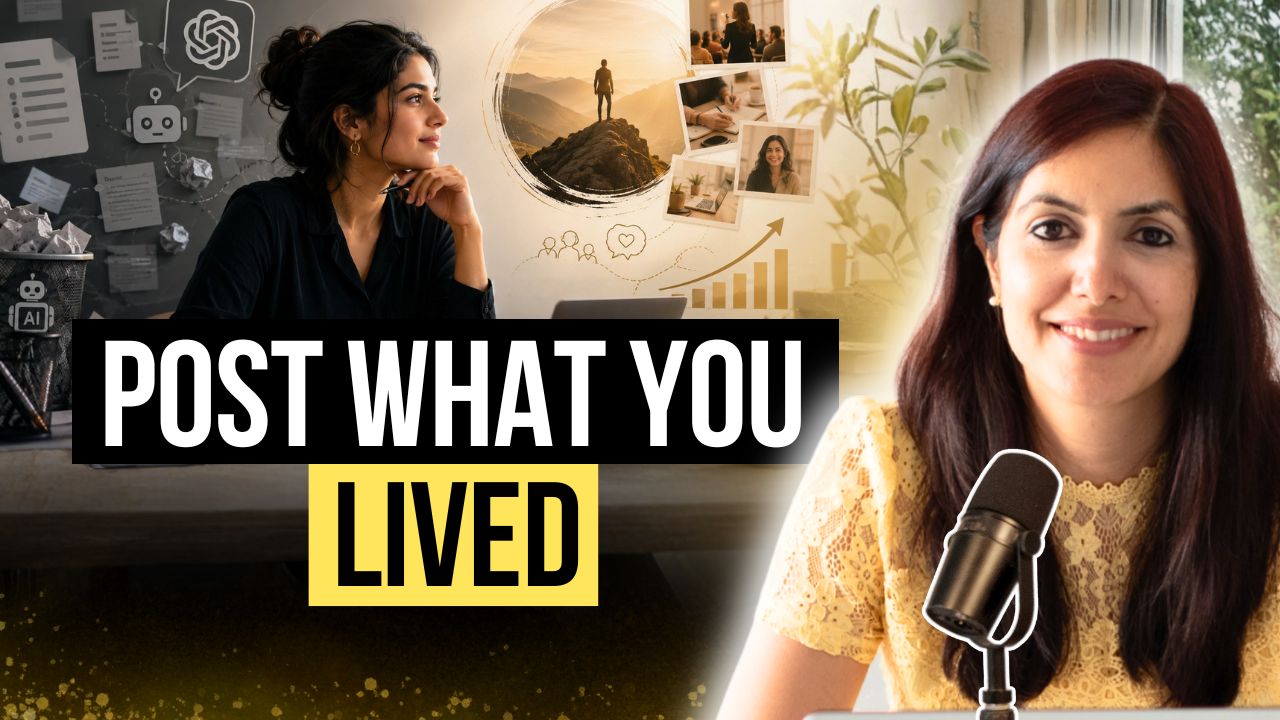
Stop Posting What You Know. Post What You Have Lived.
One of my clients explained this beautifully.
She said, “Instead of posting what I know, I need to post what I have lived.”
That sentence stayed with me.
Because most experts know a lot.
They have years of experience, client conversations, small experiments, wrong turns, lessons, and results.
But when it is time to write, they remove all of that.
They make the post sound clean, broad, and professional.
And in doing that, they remove the very thing that would make someone trust them.
I see this repeatedly in my done-for-you LinkedIn work.
The posts that often attract the most meaningful engagement are not the most polished ones.
They are the specific ones.
The client who explains what she changed after struggling to sell a small offer.
The consultant who shares the moment he realised his proposal was focused on his company rather than the buyer.
The coach who talks about the sales conversation that looked successful but never converted.
These posts work because they feel real.
My wider work is never simply about producing more content. It is about the entire client journey—from visibility and positioning to conversations, trust, booked calls, and paying clients.
Your story helps move people through that journey.
It lets them see how you think.
Why Personal Content Builds More Trust
Personal does not mean sharing every private detail of your life.
It means giving your audience enough context to understand why you believe what you believe.
Perhaps you are a female business coach who built your business while raising children.
Perhaps you became a business growth consultant because you spent years watching talented people remain invisible.
Perhaps your strongest sales lesson came from losing a client.
Perhaps you changed your entire content strategy after a post you thought would perform well completely failed.
That is useful material.
Not because the story is about you.
But because your reader can recognise themselves inside it.
They may think:
“I’m making that mistake too.”
“That is exactly how I feel.”
“Maybe I need to change the way I am doing this.”
That moment of recognition builds trust far more effectively than another generic list.
People buy when they feel understood, trust the person, see authority, and have enough interaction to feel ready. Strong content should support all four of those things.
Specific Content Creates Better Conversations
“How I” content also gives people something meaningful to respond to.
A generic post may attract comments such as:
“Great tips.”
“Thanks for sharing.”
“Very useful.”
A specific story starts a different kind of conversation.
Someone may reply:
“The same thing happened to me.”
“I changed my hook last month and noticed this too.”
“I’m struggling with exactly this part.”
Now you are not simply collecting likes.
You are learning what your audience cares about.
You are opening conversations.
And conversations are where business actually happens.
Content creates the opening, but conversations reveal pain points, build trust, qualify leads, and help people move towards a decision.
Your Content Should Belong to You
So if you are posting consistently but your content is not getting traction, ask yourself:
Could anybody else have written this?
Could AI have generated this exact post?
Does this include a real experience, result, observation, mistake, or opinion that belongs to me?
Because when your content belongs to everyone, it belongs to no one.
Make it yours.
Write about what happened.
Tell us what you tried.
Show us what changed.
Share the lesson you earned rather than the information you collected.
That is how you stop sounding like another creator on LinkedIn and start becoming someone people remember.
If you are active on LinkedIn, you should be signing 3-7 clients every month even if you only have 100 followers. Check out my Linkedin course: https://artoflifecenter.com/fully-booked-on-linkedin-cart/
KANIKA ENERGY COACH > PODCAST AND MEDIA APPEARANCES