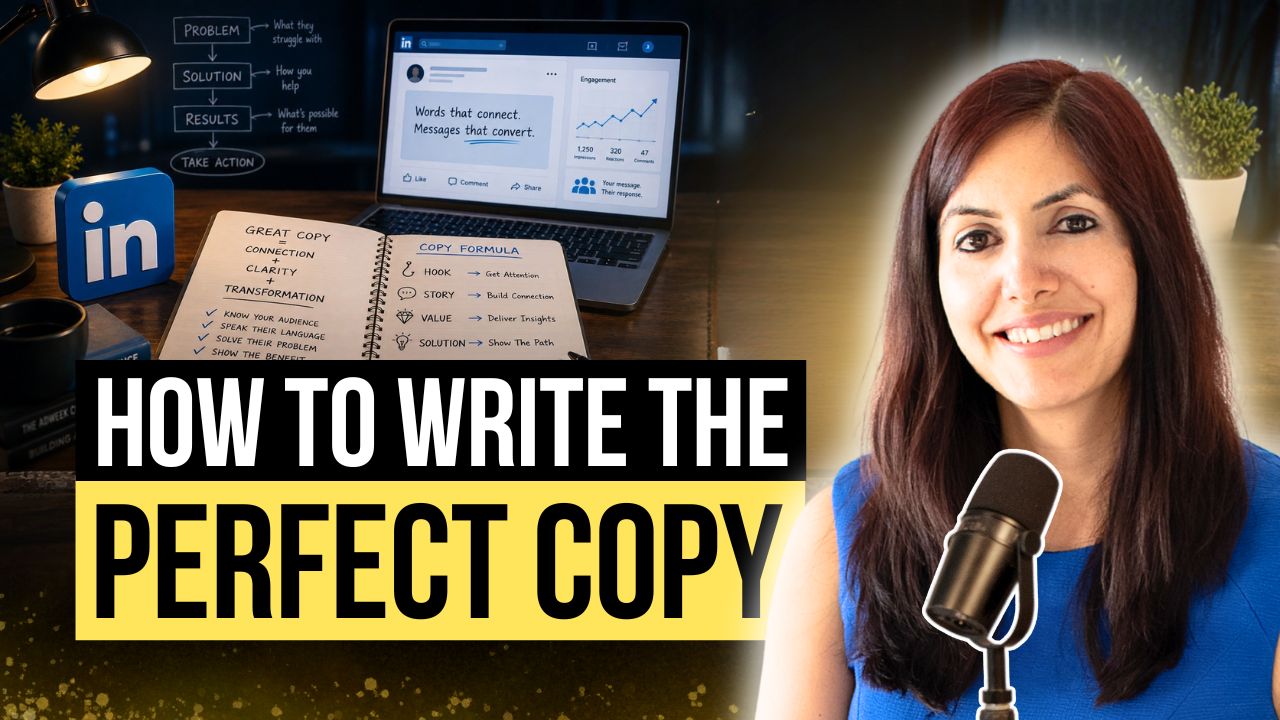
Copywriting to 10x Your LinkedIn Results Without Becoming a Writer
KANIKA ENERGY COACH > PODCAST AND MEDIA APPEARANCES
Here is something that surprises many business owners.
Only a small percentage of LinkedIn members regularly publish content.
So simply showing up already puts you ahead of most people on the platform.
But showing up is not enough.
Because while plenty of people may read the first line of your post, far fewer will continue reading.
That means you can do all the hard work of choosing a topic, writing the post, editing it and publishing it, only to lose most of your audience before they even understand what you are trying to say.
And naturally, you might assume:
“I need to become a better writer.”
“I need stronger hooks.”
“I need to sound more professional.”
“I need better vocabulary.”
But I want to challenge that.
As a business growth coach, I have found that great marketing copy is not always written.
Very often, it is found.
And the best place to find it is inside the conversations you are already having with your clients.
Your Clients Are Already Writing Your Content for You
Think about your most recent client call.
What did your client say during the first ten minutes?
Perhaps it was:
“I’m posting consistently, but my calendar is still empty.”
Or:
“I know I’m good at what I do, but nobody seems to understand the value.”
Maybe they said:
“I’m getting engagement, but it never turns into actual enquiries.”
Those sentences are content.
Not polished versions of those sentences.
Not your professional interpretation.
Their exact words.
When I work with clients as an online business coach and LinkedIn strategist, I pay close attention to the phrases people naturally use.
Why?
Because when someone sees their own thoughts reflected in your post, they stop scrolling.
They feel understood.
And that is where trust begins.
Write From Their Point of View, Not Yours
Most business owners write content from their own perspective.
They talk about what they created.
What they achieved.
How their process works.
What makes their offer different.
There is nothing wrong with that, but it is often backwards.
Your audience is not thinking about your process yet.
They are thinking about their problem.
For example, you might write:
“I spent years developing a content system that generates consistent leads.”
That explains your expertise.
But compare it with:
“I was posting three times every week, but my calendar was still empty. I kept wondering what I was doing wrong.”
Same topic.
Completely different emotional response.
The second version allows someone to see themselves in the story.
It describes their day.
Their frustration.
The moment they close LinkedIn after another post gets likes but produces no conversations.
As a business consultant, I do not simply want to tell people that I understand marketing.
I want them to feel that I understand what is happening inside their business.
That is the difference between informative content and content that creates connection.
Quote Your Clients Instead of Inventing for Them
Here is one of the most practical content habits you can build.
Start saving the exact sentences your clients use.
Look through your:
Discovery call recordings
Direct messages
Emails
Comments
Client sessions
Testimonials
Sales conversations
Do not immediately rewrite their words into business language.
Save the original sentence.
Your client might say:
“I feel like I’m doing everything, but nothing is really moving.”
Do not turn that into:
“Many entrepreneurs struggle with operational inefficiencies.”
Nobody talks like that over coffee.
The original sentence has emotion.
It feels human.
It is something another business owner might read and immediately think:
“That is exactly how I feel.”
You are not always the writer here.
You are the translator.
Your job is to take what your clients are already saying and help more people recognise the meaning behind it.
Why Clever Copy Often Fails
There is so much pressure online to sound intelligent.
To create a brand-new phrase.
To write the perfect hook.
To make every sentence impressive.
But clever copy can create distance.
Clear copy creates recognition.
The goal is not to make someone think:
“That writer is very smart.”
The goal is to make them think:
“She understands exactly what I’m dealing with.”
That matters whether you are a business strategy coach, small business consultant, female business coach, or another service provider trying to attract clients online.
Your prospective client is rarely searching for the person with the fanciest vocabulary.
They are searching for someone who understands the problem and can help them solve it.
Your content should demonstrate that understanding before they ever book a call.
Turn One Client Sentence Into a Full Post
Let me show you how simple this can be.
A client once said to me:
“I don’t have to think about marketing anymore. My calendar just fills.”
I did not create that sentence.
He did.
But that one line holds the entire transformation.
Before working together, he had to constantly think about marketing.
He had to find ideas, create content, stay visible and wonder where the next opportunity would come from.
Afterwards, there was a system supporting him.
His content was going out.
The right conversations were happening.
Qualified calls were being booked.
So one client sentence can become:
The opening hook of a post
A client success story
A case study
A sales-page headline
An email subject
A testimonial graphic
A video topic
Their words become your copy.
Then your copy reaches someone else who thinks:
“That is what I want too.”
That is how the loop works.
Content Should Lead Somewhere
Of course, attracting attention is only part of the process.
Your post should also create a path forward.
Someone might read your content and feel understood, but what happens next?
Do they know what you help with?
Can they see how your expertise relates to their problem?
Is there an easy way to start a conversation with you?
Your content should not exist separately from your business.
It should support your positioning, build trust and help the right people move towards a conversation.
A strong sales and marketing journey is not about adding more information. It is about helping people understand their real problem, trust that you can solve it and see a clear direction forward.
This is why the best business coaches for entrepreneurs do more than teach content tactics.
They help clients connect content, conversations, positioning and sales.
Listen Before You Write
Before you create your next LinkedIn post, do this:
Open your recent messages.
Look through your call notes.
Listen to the first ten minutes of a discovery call.
Find one sentence that made you pause.
One sentence that revealed frustration, confusion or desire.
Use that as your opening.
Then build the post around what that sentence really means.
You do not need to invent another clever idea.
Your audience is already telling you what to write.
You simply need to listen.
Because when your content uses the words your ideal client already has in their head, it becomes easier for them to recognise themselves.
And recognition leads to trust.
Trust opens conversations.
Conversations create clients.
If you are active on LinkedIn, you should be signing 3–7 clients every month, even if you only have 100 followers. Check out my LinkedIn course:
https://artoflifecenter.com/fully-booked-on-linkedin-cart/
KANIKA ENERGY COACH > PODCAST AND MEDIA APPEARANCES